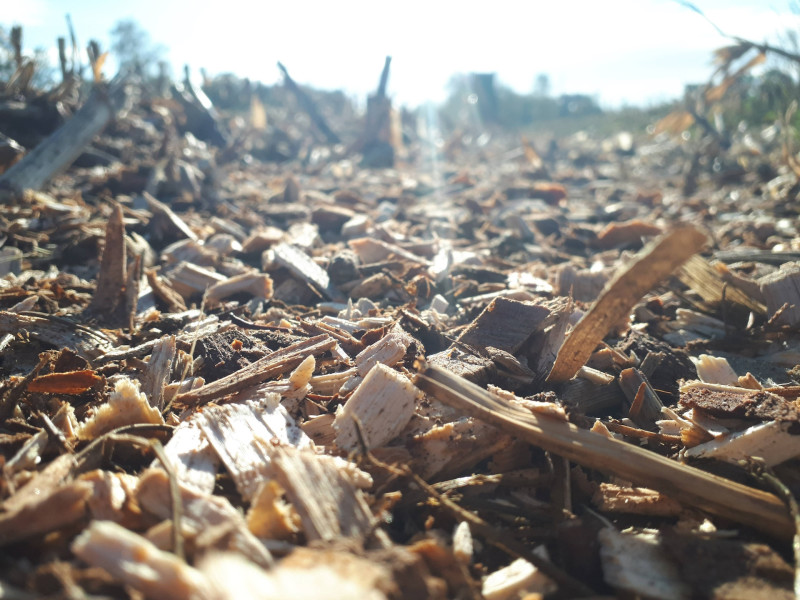
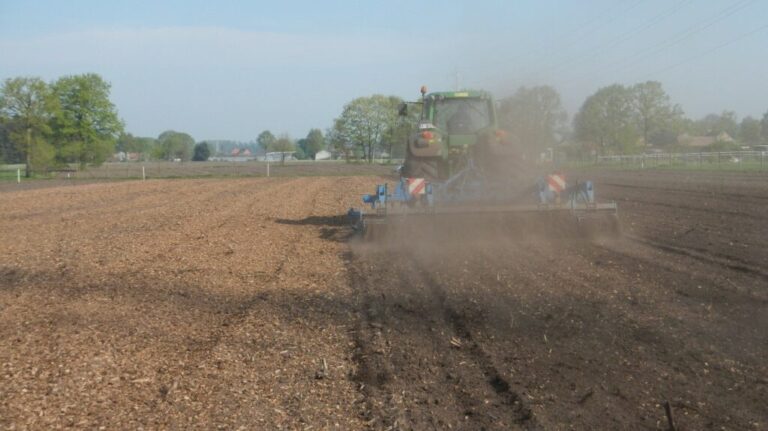
What started as an experiment is today a practice that is taking hold all over Flanders. From our work on landscape management, we at Boerennatuur Vlaanderen were looking for ways to valorise the released wood in a way that was useful and accessible to farmers. That's how we ended up with the incorporation of wood chips into the soil in 2016. For years, legislation was a stumbling block in this regard, but it has since been eased considerably. Today, we support farmers throughout Flanders to use this simple technique to enhance their soil quality and landscape, including in North Limburg
Fientje Verbruggen, project coordinator Farmers' Nature Flanders.

Article published in Farmer & Gardener - 23 October 2025
Bottom gold
In North Limburg, the Leader project Bodemgoud (Soil Gold) is running in the municipalities of Pelt, Peer and Hamont-Achel. With this project, we are returning to the basics of the technique: the incorporation of wood chips originating from local landscapemanagement. The municipalities involved have been actively pursuing municipal wood edge management for several years. Until now, the wood edge management contractor often became the owner of the released wood. This was then often sold on to biomass plants for combustion and energy generation.
With Soil Gold, we want to close the loop locally. Farmers are introduced to the technique of incorporating wood chips as soil enhancer and at the same time researchknow the interest among farmers to process the local wood. The project started in September 2024 and runs until June 2026. Interest was high in two calls to farmers (in October 2024 and September 2025). To distribute the available volume fairly, it was decided to allocate a maximum of 2 ha per farmer. In the meantime, 14 farmers received wood chips, accounting for more than 2 hectares. than 22 ha that was zoned in.
For the scientific monitoring of the incorporated plots, we cooperate with PVL Bocholt. Underneath, we look for how wood chips affect soil life. Which bacteria, fungi and other micro- and macro-organisms benefit? How does that improve the soil structure? Regionaal Landschap Lage Kempen also plays an important role in the project. This organisation coordinates municipal wood edge management in HamontAchel and the maintenance of future trees in wood edges in the participating municipalities. Within Soil Gold, we thus improve both the soil quality of the incorporated plots and the landscape quality of the agricultural area
What about legislation
Vlarema, the legislation on sustainable materials management, stipulates the conditions under which wood chips may be incorporated directly on an active agricultural plot as a soil improver. In April 2024, these regulations were relaxed (the mandatory raw materials declaration was scrapped), making the administrative threshold a lot lower.
Those who want to incorporate wood chips today must be able to demonstrate through analysis that the material meets some quality requirements. Specifically, these are: a minimum carbon nitrogen ratio (C/N) of 50; a minimum carbon phosphorus ratio (C/P) of 500; and an organic matter content of at least 80% on dry matter.
The full conditions can be found under section 2.3.3.5. of Vlarema. If the wood chips meet these conditions, you may use them solarder resource statement at the soil take effect.
Only subsidies for proprietary wood chips
Do you want to incorporate wood chips in your agricultural plots? Then you may be able to use the eco-scheme ‘Increase organic carbon content’ for this. This eco-regulation offers farmers a financial incentive to improve soil quality through the incorporation of organic material. Specifically, you have to incorporate at least 10 tonnes of woodchips per hectare and this is allowed once every five years. To prove that you have effectively incorporated the wood chips, take a photo at the time of spreading or incorporation and submit it via the LV Agrilensapp.
However, there are some conditions you need to take into account. The subsidy only applies to company-owned wood chips, originating from small landscape elements on your own farm. Via the collection application or a management agreement, you must be able to demonstrate from which landscape element the wood comes.
Wood edges, hedges, hedgerows and pollarded trees, as well as the grubbing up of perennial high and low stem fruit crops, ornamental shrubs and the annual fallout from tree cultivation such as avenue trees, fruit trees, forest and hedge plants and solitary trees are eligible for the subsidy. The payment of the subsidy is based on the area of the small landscape element from which the wood chips come.
In addition, legal quality control remains in place when applying the eco-regulation. The woodcock press must meet the conditions set out in Vlarema, which means that an analysis of the material is necessary.
Gradual spreading
After years of experience with woodchip incorporation, we continue to refine and expand this technique. Within Soil Gold, we are testing the gradual spreading of wood chips, an approach designed to distribute the organic matter content on a plot more evenly. Once the harvest is in, a soil scan is performed that closely maps the organic matter content of the plot. Based on this scan, tractor task maps are drawn up. Thus, more wood chips can be spread in zones with lower organic matter content, while less is needed in richer zones. In this way, we aim for a better balanced soil structure over the entire plot.
Are you curious about this technique or just want to find out more about incorporating wood chips into the soil?
On Wednesday 5 November, together with B3W.Vlaanderen and the project partners of the Leader project ‘Bodemgoud’, we are organising a demo moment in Pelt where you can see everything up close.