
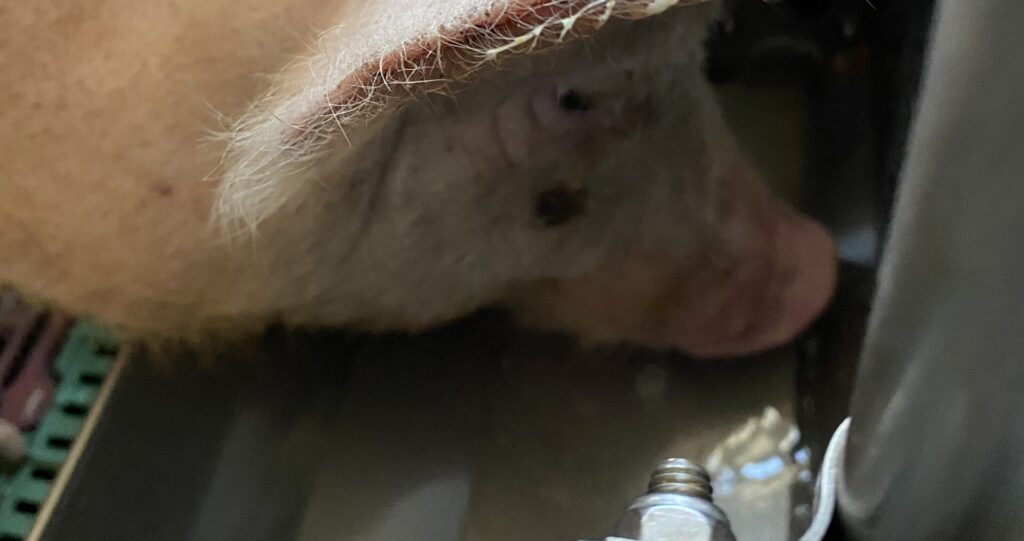
As part of the WAVE project, we are launching an innovative Precision Livestock Farming (PLF) technique in one of our fattening pig units.
What do we do?
We measure the drinking water consumption of fattening pigs at loft level using three different water meters.
This allows us to closely monitor and analyse consumption
Why?
Monitoring drinking water consumption helps us detect anomalies early.
- Excessive consumption may indicate leakage losses, spillage or feed errors
- Consumption too low may indicate health problems in the animals or a malfunction in the drinking water system.
How do we measure?
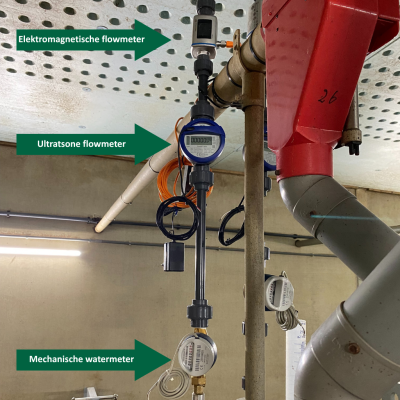
Three types of water meters were installed on each of the loft water pipes:
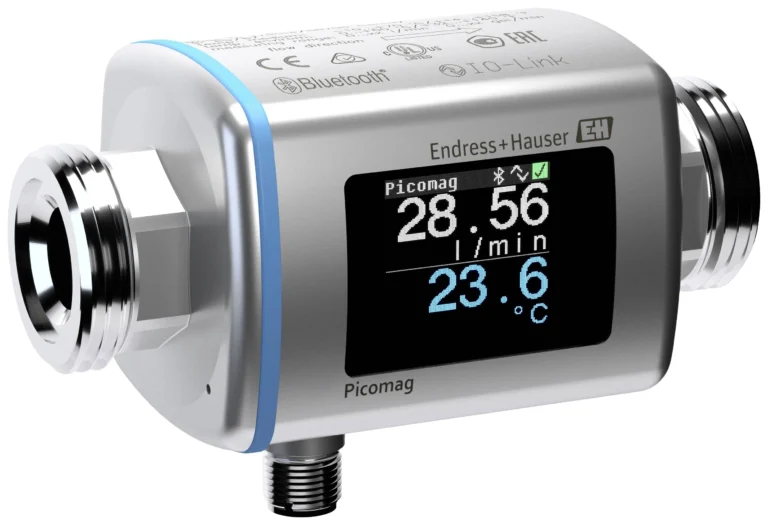
- An electromagnetic flowmeter
- An ultrasonic flowmeter
- A mechanical flow meter
With this setup, we can compare the accuracy and reliability of different measurement methods. Thus, we investigate whether an affordable water meter can be a good alternative to more expensive, sophisticated systems
How do these 3 flow meters work?
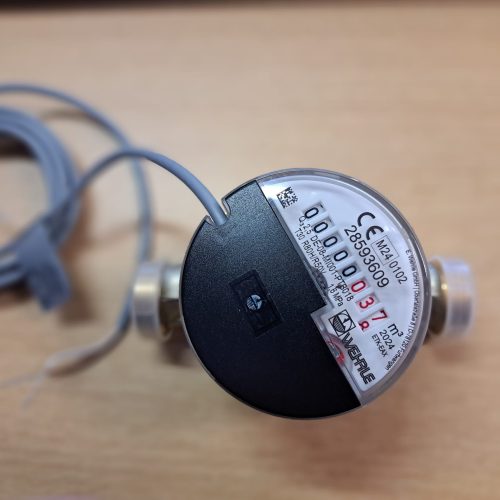
Mechanical flow meter
A mechanical water meter is a measuring instrument that accurately records the consumption of water by means of an internal rotating mechanism. Once water flows through the pipe, the flow sets an impeller or turbine in motion. That rotation is mechanically transferred to the counter, where the total water consumption is displayed in cubic metres (m³).
How does a mechanical water meter work?
- The operation is simple but effective:
- Water flows through the meter.
- An impeller or disc rotates with the flow.
- The mechanical counter converts this movement into a readable value.
Because the system is purely mechanical, the meter does not need electricity or batteries. This makes it reliable and low-maintenance, even in long-term use.
Advantages of a mechanical water meter
- Proven technology: A reliable method of water measurement for decades.
- Without power supply: Works completely independently.
- Robust and durable: Resistant to changing conditions.
- Easy to maintain: Few moving parts and easy to check.
Applications
Mechanical water meters are used in homes, flats, businesses and industrial plants. They are suitable for both cold and hot water and are often used as main or intermediate meters to measure the consumption of individual units.
Ultrasonic flowmeter
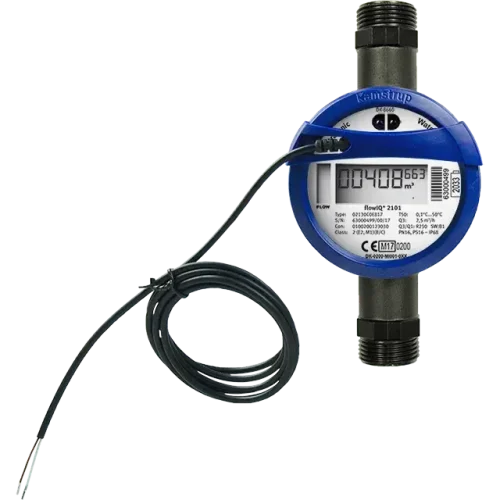
An ultrasonic flowmeter is an advanced measuring instrument that measures the flow rate and flow of liquids using sound waves. Instead of moving parts, as in a mechanical water meter, this technology works completely non-contact and electronically. This makes the measurement highly accurate, reliable and maintenance-free. This meter runs on a battery that can last up to 10 years.
How does an ultrasonic flowmeter work?
Its operation is based on the principle of ultrasonic sound waves:
- Two sensors send and receive sound waves through the flowing liquid.
- As the water moves, the time the sound takes to travel from one sensor to another changes.
- The flow meter calculates the flow rate and total consumption based on this time difference.
As there are no moving parts, wear and tear is minimal and the measurement remains accurate even after years of use.
Advantages of an ultrasonic flowmeter
- Highly accurate: measures even small differences in flow.
- No moving parts: No wear and tear, so less maintenance.
- Suitable for various liquids: Works for both clean and lightly soiled water.
- Simple installation: Often also applicable as a clamp-on variant, without opening the pipe.
- Digital readout: instant, clear display of measurement data.
Applications
Ultrasonic flow meters are widely used in industrial, utility and drinking water applications, where accuracy and reliability are important. They are ideal for situations where maintenance is difficult or where a non-contact measurement is desired, for example for large pipes or hard-to-reach places.
Electromagnetic flowmeter
An electromagnetic water meter is an accurate and low-maintenance measuring instrument that determines the flow rate of conductive liquids using electromagnetic induction. Unlike mechanical meters, this technology has no moving parts, preventing wear and tear and ensuring long-term reliability of measurement.
How does an electromagnetic water meter work?
The operating principle is based on Faraday's law:
- A magnetic field is generated in the measuring tube of the water meter.
- When a conductive fluid (such as water) flows through this field, a voltage difference is created.
- This voltage difference is proportional to the flow rate of the water and is electronically converted to the measured flow rate.
The measurement is completely independent of temperature, pressure or density of the liquid, ensuring constant and highly accurate operation.
Advantages of an electromagnetic water meter
- High accuracy: even at low flow rates and varying conditions.
- No moving parts: No mechanical wear or pressure loss.
- Low maintenance: Long service life and minimal calibration required.
- Versatile application: Suitable for a variety of conductive liquids, such as drinking water, waste water or process water.
- Digital signal output: easy to link to monitoring and management systems.
Applications
Electromagnetic water meters are widely used in water distribution, industrial plants, irrigation systems and wastewater treatment plants. Their high measurement accuracy and maintenance-free operation make them an excellent choice for both operational monitoring and billing measurement.
And the next step?
All water meters are connected to a data logger. This continuously logs the measurement data and transmits them to an online platform. This allows us to monitor water levels real-time and remotely.
De proefopstelling in de praktijk
Voor deze test hebben we één afdeling geselecteerd. Om de meetmethoden te vergelijken, hebben we op elk hok — twaalf in totaal — de drie verschillende watermeters (mechanisch, ultrasoon en elektromagnetisch) geplaatst. Daarnaast hebben we exact dezelfde drie meters op de hoofdwaterleiding van die afdeling geïnstalleerd ter controle.
In de onderstaande grafiek is de gemeten wateropname per dier per dag uitgezet tegen de rondedag voor alle twaalf de hokken:

Is er een verschil tussen de verschillende soorten watertellers?
De vraag van deze analyse is natuurlijk of de verschillende technologieën ook andere meetresultaten opleveren. De statistische analyse leverde een aantal opvallende conclusies op:
Geen ‘gouden standaard’: Binnen deze specifieke proef kon er niet worden vastgesteld welke sensor het ‘meest accuraat’ meet, aangezien er in de opstelling geen onafhankelijke referentiemeter of ‘gouden standaard’ beschikbaar was.
- Significant verschillende metingen: Wel heeft de analyse aangetoond dat de verschillende types sensoren onderling significant verschillend meten.
- Mechanisch versus ultrasoon: Er werd geen significant verschil vastgesteld tussen de metingen van de mechanische en de ultrasone sensoren. Dit is een interessante vinding, aangezien het suggereert dat de doorgaans goedkopere mechanische meters vergelijkbare resultaten opleveren als de duurdere ultrasone sensoren.
- Elektromagnetisch wijkt af: De elektromagnetische sensoren gaven daarentegen wel een statistisch verschillend resultaat t.o.v. mechanische en ultrasone.
Belangrijke kanttekening bij de resultaten
Hoewel deze eerste analyses waardevolle inzichten bieden, is het belangrijk om de resultaten met de nodige voorzichtigheid te interpreteren. De drie sensoren waren in de opstelling namelijk telkens in dezelfde vaste volgorde achter elkaar geplaatst. Hierdoor kan een mogelijke mechanische of hydraulische invloed van de ene sensor op de daaropvolgende sensor niet worden uitgesloten of afzonderlijk worden geanalyseerd.
